
Moss Poles 101
A Rousseau Plant Care guide to choosing the right plants, avoiding common mistakes, and getting better results with moss poles.
Moss poles can be amazing. They can also be pointless, annoying, or overkill if the setup is wrong.
About Me
I’m Tyler, founder of Rousseau Plant Care. I’ve spent years growing climbing plants indoors and designing products to solve the problems that come with it.
This presentation is based on what I’ve seen actually work over time, not just generic plant advice.
"I’ve spent an unreasonable amount of time thinking about moss poles so you don’t have to."
Benefits of Moss Poles
When the setup is right, a moss pole can change both how a plant grows and how it fits into your space.
Larger Leaves
Rooting triggers mature morphology
Shorter Internodes
Tight, dense vertical stacking
Stronger Structure
Stems thicken dramatically
Easy Propagation
Chop and extend with pre-rooted stems
Not every plant needs a moss pole
The best support depends on the plant's growth habit.
Great Candidates
Vining climbers with active aerial roots looking for a host.
Simple Support Needs
Plants that need to stay upright but lack strong rooting behaviors.
Not Necessary
Self-heading or bushy plants. They grow from a central crown and physically cannot climb.
Good Candidates
Good candidates are plants that naturally climb, attach, and benefit from vertical growth. Start with a fresh cutting, or take a trailing Philodendron, Scindapsus, or Pothos and attach it to the bottom of a new moss pole to let it climb from scratch.
"If the plant wants to climb, great. If it wants to sit there and be weird, let it."
Early Growth & Establishment
A small cutting does not always want to climb right away. Sometimes it needs to build a base before it can really use the pole.
It takes time to build a base
Small, freshly planted cuttings can be slow to root into a pole. They may not have the base root system in the soil yet to support active upward climbing.
Trailing is part of the process
Sometimes a cutting won't really root onto the pole until it is 3–4 leaves up. In some cases, it actually makes sense to let the plant trail at first until the base root system gets stronger.
"Sometimes the plant is not failing. It’s just underqualified for the job at the moment."
What Healthy Moisture Looks Like
A healthy moss pole stays moist long enough to be useful, then dries in a manageable window.
The Ideal Drydown Cycle
The Timing is Crucial
The ideal time to water is when the front of the moss pole is dry to the touch, but the back still holds some moisture.
Watering too frequently? It stays wet too long. Algae can take over the surface, blocking airflow, and risking stem rot.
Watering too infrequently? The moss gets crispy, the roots desiccate, and the plant gets heavily stressed trying to survive.
The 4-to-7 day cycle: Perfect. The system breathes, roots push deep into the back to seek the remaining moisture, and growth explodes.
Watering & Fertilizing
The best watering method is one that hydrates the whole pole thoroughly and predictably. I also like to use a dilute nutrient solution with every watering while the plant is actively growing.
Light & Growth Zones
A moss pole is most rewarding when the plant has enough light to actually use it.
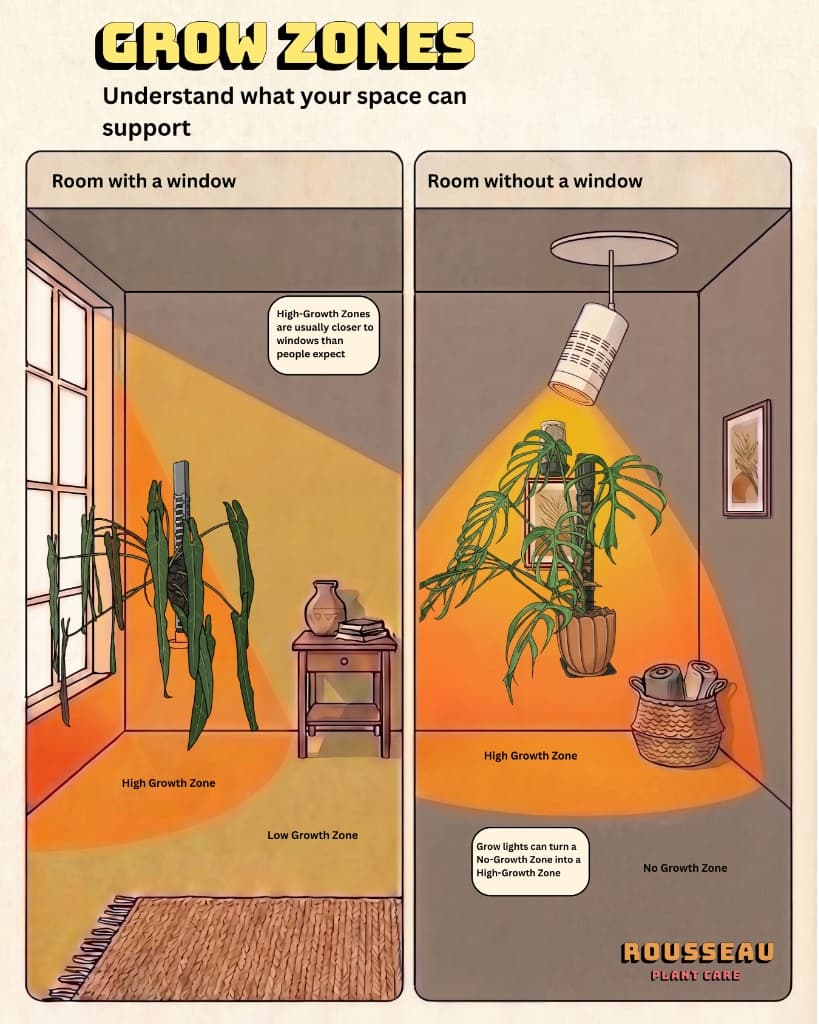
Low Growth Zone Details
Meaningful but slow growth. The plant will push new leaves, but they generally won't size up. Aroids will struggle to mature or fenestrate. Dry-down takes longer, making watering less forgiving.
May work, but slower progress and lower reward. The aerial roots will attach eventually, but the internodes may still be spread out.
If using a pole, ensure you are tethering the nodes tightly so the roots find the moss instantly. Patience required.
DIY Moss Poles
Building your own moss poles from hardware cloth or wire mesh is a great right of passage. It saves money and works incredibly well—if you can manage the drawbacks.
The Challenges of Open Mesh
Extreme Evaporation
A completely open DIY moss pole exposes 360 degrees of moss to the air. In a standard living room, it can bone-dry in 24 hours, making it incredibly difficult to keep consistently hydrated.
Harder to Extend
When the plant reaches the top, splicing wire mesh and zip ties together while wrangling an active, heavy vine is a chaotic juggling act.
Labor Intensive
Cutting wire creates sharp snags, limits aesthetic appeal in living spaces, and requires dedicating serious workbench time to craft them.
What makes Rousseau different
A good plant support should do more than hold a plant up. It should make the whole setup work better.
Modular Integration
Designed around real growing problems. Our system expands as your plant grows, ensuring continuous vertical scaling without repotting.
Moisture-Supporting Structure
Properly retains water in the sphagnum core, providing a perfectly hydrated environment for aerial roots to explode into.
Wall Mounted Innovation
A major advantage. Wall mounting opens up options for stability, space saving, and presentation.
- Better use of vertical space
- More stable support for larger plants
- Cleaner integration into living spaces
The Full Rousseau System
The pole is only one part of the result. The system is what makes it work.
1. The Right Plant
2. The Right Support
3. Enough Moss
4. Good Hydration
5. Enough Light
6. Patience
7. Guidance
Why do moss poles frustrate people?
A diagnostic guide to common structural issues and failures.
"A moss pole should support growth, not become a side quest."
Using non-climbing species or multi-vine setups.
The plant does not have the energy to grow upwards.
A major pitfall. Loose or underfilled poles dry out in 24 hours and make the system much harder to manage.
Roots hit dry moss, abort, and die.
Vines grow away from the pole instead of being tethered early.
A pole will not fix an already weak, dying plant.
Real Examples
Once you see the right and wrong use cases side by side, the decision gets much easier.
Right plant.
Right support.
Right moisture.
Right light.
Moss poles work best when they match the plant’s natural growth habit and are supported by the entire Rousseau system.
Ready to build yours?
Check out the store to find the right pole size and hydration setups for your space.
Shop Rousseau